Posts

Silvergate was down - blame it on Coinbase

Over the past week, Silvergate Capital (SI) has lost more than 25% of its value. Is this a reason for its investors to be alarmed? I don't think so. The stock was down because investors rushed to buy Coinbase when it began trading publicly. They realized profits from SI's stock sale to diversify their exposure to crypto in the public markets. Yesterday, SI reported record earnings. SI, which serves major crypto firms such as Coinbase, Gemini and Kraken, added a record 135 digital currency customers in Q1–more than it added in all of 2020. It also reported sensational growth for SEN Leverage - it's latest product offering. SEN Leverage was the fastest growing product, with $196.5M in outstanding balance. SEN Leverage is expected to be a massive contributor in growing SI's revenues and profits. It's critical to serving clients who are looking to make leveraged bets in this current market under one roof. Bottom line: I remain bullish on SI despite the recent slump, and...
Amazon is coming to you Google Maps

If you ask which is the bigger threat to the other, Amazon or Google? Many will argue that it's Google, because it's dead set on diversifying its business and is investing heavily in promoting it's cloud business. Thus encroaching on Amazon's profit machine -AWS. I beg to differ.  As mentioned in a previous article , Amazon is already closing in on Google's advertising business and despite all Google's investments, it's clear that GCP is not going to catch up to AWS any time soon. Now Amazon is posing yet another threat to another big business for Google - Mapping. How So? AWS is Amazon's silent (but deadly) superpower. It's a "silent server" for a huge swath of the digital economy, powering the operations of millions of companies from Netflix to Slack and Shell. Last quarter  it made up over half of Amazon's total profit. Recently AWS announced a new location service called "Amazon Location". No, this is not not a real-time p...

Now is the time to get on Peloton

Although Peloton's stock debuted in late September 2019, it didn't soar until the pandemic hit. Before the pandemic, the company was growing well, but it was spending a lot of money to grow and investors were skeptical if there was enough market for its products. Then the pandemic hit, fitness enthusiasts turned to Peloton to provide them with workout options while gyms were closed, sales skyrocketed, and Peloton's stock become one of the biggest pandemic success stories. Since January, the stock has lost close to 40% of its peak value. This is primarily because of concerns that the company could return to its net-loss financials as the pandemic wanes. After all, until the pandemic, Peloton was not very profitable. As vaccines started getting rolled out many investors started to wonder if Peloton can sustain the growth it saw in 2020. I think it can. As mentioned in a previous article , I think Peloton will outlive the pandemic and continue to post strong numbers. Its moat ...

Amazon is beating up on Google and Facebook

When people think of digital advertising, they think of Google, Facebook, Twitter, Snapchat etc. But what about Amazon and Microsoft? Maybe you should just Bing it... said no one ever. Microsoft's search engine Bing is often portrayed as a bit of a joke in comparison to Google. It just happens to be one of those jokes that makes billions of dollars of revenue. Per Chartr , in 2019 while Snapchat and Twitter combined generated $5.2B in revenues, Bing did $7.5B. Basically, Bing is a $7.5B joke that's over 30% bigger than Snapchat and Twitter combined. The fact that Bing is often ridiculed, but is actually an enormous business, gives some context as to how important search actually is. It truly is our gateway to the online world, and unlike other forms of digital advertising it monetizes actual user intent. In some industries it's not uncommon for companies to pay Google $40 or $50 for every individual click on their ad (usually for phrases like "insurance", "m...

Nike: Just Do It, DTC

Even though Nike reported higher than expected third-quarter profits, its stock has been trending down since that earning call. The primary reason for the decline is sales growth, which was hurt by widespread port congestion in the United States and ongoing store closures in Europe. Although the global health crisis still leaves an overhang of uncertainty, Nike said it anticipates lockdowns will start to ease in Europe in April, and delivery windows will slowly improve in North America through the remainder of the year. But what got me so hyped about Nike is its direct-to-consumer (DTC) business which grew 20% YoY, to $4B putting Nike is on track to sell $16B DTC – more than a 40% of all Nike brand revenue. Online sales are fueling this growth. They surged by another 59% in this quarter after the 82% in the last quarter, enabling Nike to book $1B in sales online in North America for the first time. This is super impressive. As mentioned in a  previous article , Nike's ability to th...

The crypto mainstream-ification intensifies

Over the past year, Bitcoin has increased ~9x in value as corporate and retail investors have poured into cryptocurrency. In January, the crypto market hit $1T in total value (mostly Bitcoin). Now, the mainstream-ification is intensifying: Venmo-owner PayPal, which has a whopping 377M active accounts, officially launched "Checkout with Crypto" in the US, allowing users to pay with crypto at online stores. And in the coming months, PayPal will expand crypto checkout to 29M merchants. Customers with PayPal digital wallets can pay in Bitcoin, Ether, Bitcoin Cash, and Litecoin. This comes after Visa also announced that it'll allow people to use the cryptocurrency USD Coin (a US dollar-backed stablecoin) to settle payments. How will it work? Paying with crypto... but not really paying with crypto. Customers' crypto holdings will be converted into fiat currencies (like US dollars) at checkout. It's kind of like selling a fraction of your BTC, then using the sale money t...

Affirm: If you buy now, you'll pay for it later

Affirm had one of the hottest IPOs of the year. Its stock was priced at $49 in January and quickly climbed to nearly $140; that's over $40B in market cap. Since then - more precisely since reporting its first earnings report as a public company- the stock has lost over 50% of its peak value. This is despite the earnings beat. So what changed?  Back story: Affirm did forecast a wider than expected loss for 2021 which cast a dim spot over its earnings but that's not the primary reason the stock has been in a downward spiral. That's happening due to fears over increased competition and valuation going too far. Many analysts came out with what amounts to bearish ratings. Honestly, this is completely understandable considering the massive and out-of-this-world valuation for Affirm which is, after all, still a small fintech company. Also, SoFi - which has similar if not better growth prospects than Affirm - had recently signed a definitive agreement to go public via a SPAC that v...

Popular posts from this blog

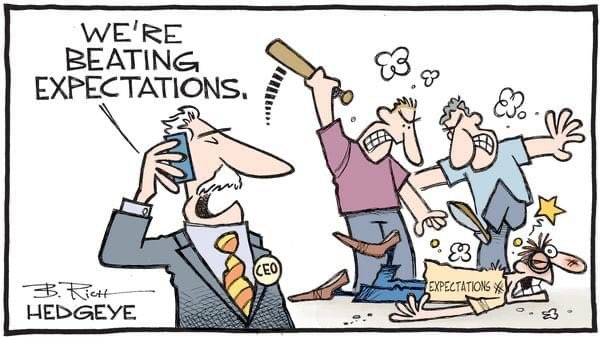
Why the stock market is beating expectations

Airbnb is not Uber and that's great news for Airbnb

Microsoft vs. Sony: The console battle and the gaming war