Posts

Apple is bundling up for winter

On September 15th, Apple announced Apple One and Apple Premier; two monthly subscription plans that bundle Apple’s premium services - Apple Music, Apple TV+, Apple Arcade, and iCloud storage, for either individuals or families. Premier adds on Apple News+ and Apple Fitness+. What is the strategy and motivation driving this announcement?  While Apple’s primary business model remains selling premium hardware at high margins, the company has a longstanding goal of increasing its services revenue. The latest bundles are all about the latter. Let me explain: They neither help Apple connect better with its customers nor reduce churn on Apple’s hardware (HW) products - not that Apple needs any help connecting with its customers or reducing churn. Apple is a darling for its customers and its churn is near zero. More importantly, they don’t aim at expanding Apple’s HW market share. They don’t make an iPhone (or any Apple HW for that matter) any more accessible and do not help in any way mov...

Arm can make Nvidia the most important chip maker

In the previous post , I discussed that Nvidia’s deal for Arm is very smart because it was structured as a majority stock acquisition. In this post, I will discuss the strategy driving the acquisition and how Arm will help make Nvidia the most important chip maker in the world. Last July, Nvidia surpassed Intel to become the largest U.S. chip maker by market value. However, by most measures, Nvidia remains a niche player; compared to Intel’s $72 billion in revenue last year, Nvidia’s sales were a little over $11 billion. So how can Nvidia grow to its market value? Nvidia thinks the answer is Arm. This answer is not obvious to everyone, though, because the two companies’ business models couldn’t have been more different. While Nvidia sells vertically integrated solutions and doesn’t share its IP, Arm sells modular designs that are available to everyone in the ecosystem.  Nvidia started as a niche player and made its name making and selling best in class graphic processor units (GPU)...

Nvidia to SoftBank: Give me your Arm

Last week, Nvidia announced that it is acquiring Arm from SoftBank for $40 billion. Under the terms of the transaction, Nvidia will pay SoftBank $21.5 billion in stock and $12 billion in cash. SoftBank may also receive up to $5 billion in cash or common stock if Arm meets certain financial targets. Finally, Nvidia will issue $1.5 billion in equity to Arm employees.  Let’s meet the two main parties involved in the biggest chip deal in history and evaluate who got the better deal:  SoftBank is a Japanese conglomerate famous for its big bets on the tech sector. Some have worked (e.g. Alibaba) while many have flopped (e.g. WeWork). Arm will join the second group and SoftBank is a loser in this deal. Selling Arm for $32 billion - not including $5 billion in potential add-ons- means that Arm was yet another flop investment. Had SoftBank bought Nvidia shares or, for that matter, an ETF tracking the S&P 500 - which is up 55% since then- it would have gotten a much higher ROI than...

SPAC: Why many unicorns won't hop on the SPAC wagon

Image
2020 has certainly been the year of blank check acquisition companies - or SPACs.  That's how Nikola- the sexy electric truck shop-, Utz - the iconic snacks company- and Virgin Galactic went public earlier in the year. Plus, it's also how electric vehicle makers Fisker, Canoo, and Lordstown Motors announced they will go public. Plus Plus, famous investor Bill Ackman recently took his SPAC (Pershing Square Tontine) public in the largest-ever blank-check IPO (it raised A whopping $4B). The objective is to buy a mature unicorn. Ackman actually said Pershing might buy a “mature unicorn” 6 times in the filing. However not all private companies are psyched about merging with SPACs to go public. Airbnb reportedly turned down an offer to merge with Bill Ackman's SPAC, saying it prefers going public via traditional. Airbnb isn't alone. Snowflake, Slack, Shopify and BigCommerce are other flashy SPACs that declined the backdoor to going public and opted for the front door through...

SPAC Investing: Look before you leap

Image
In a previous post, " SPAC: The investing trend du jour ", I discussed what's an SPAC and why plenty of private companies are preferring to merge with a blank check firm or SPAC rather than go through the time-consuming and expensive process of raising money through a more traditional IPO. With all the excitement around SPACs, is it a good idea for investors to hop on the SPAC wagon? The case against investing in SPACs SPAC historical track record is not great: Goldman Sachs said in a report earlier this month that the 56 SPACs it looked at since January 2018 outperformed the S&P 500 by 11 percentage points in the first three months after an acquisition but lagged the broader market in the 12 months after the deal. And a recent study by IPO research and investing firm Renaissance Capital found that 89 SPACs that had gone public since 2015 have posted an average loss of 18.5%, compared to an average gain of 37.2% for traditional IPOs. A typical SPAC will offer stock a...

SPAC: The investing trend du jour

Image
2020 is a year for the record books and its latest mania is SPAC investing. A SPAC, also known as blank check company, is a special purpose acquisition company and it’s the hottest trend in investing. According to Goldman, there have been 51 SPAC offerings in 2020, raising a record $21.5 billion, up 145% from the same period a year ago. A SPAC is essentially a shell company listed on a public exchange that uses the funds it raises from selling shares to acquire a private company or startup within a certain time frame, typically two years. In plain English: A SPAC is a company without a company.  SPACs go public for the sole purpose of one day acquiring a real company.  SPACs collect cash from new investors in the  initial public offering (IPO), even though those investors don't know what they'll end up owning.  The SPAC has 2 years to buy a real company, or the $$ gets returned to the investors.  SPACs have been around for years, but gained popularity recently a...

Slack got smacked

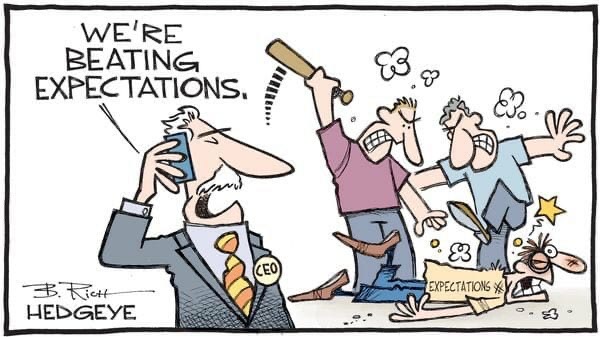
Last Tuesday, Slack reported expectations-beating earnings but its stocked tanked. This is because Slack didn't deliver the Zoom-like growth that investors were expecting.  Slack and Zoom were both expected to be work-from-home (WFH) winners but their realities are turning out to be very different. While Zoom's sales more than quadrupled compared to the same quarter last year, Slack's grew at 49% - just about the same as the previous two quarters. So why is Slack slacking on growth while Zoom is crushing all expectations? The process to buy Slack is much longer than Zoom's. Slack's primary customers are large enterprises. Convincing these enterprises to buy Slack requires salespeople and involves endless negotiations with IT departments who always start with "but we have Microsoft Teams for free". Zoom is more plug-and-play. Unlike Slack, Zoom doesn't require integration with any other enterprise software or tools. Also, the alternatives to Zoom are a...

Popular posts from this blog

Microsoft vs. Sony: The console battle and the gaming war

Why the stock market is beating expectations

Airtags: The ultimate brand power move